Gateway to Civil War in Missouri’s “Little Dixie” River Valley
The Missouri Legislature had a decision to make. Throughout 1860, Claiborne Fox Jackson successfully ran for governor as a moderate on the issue of secession. During his inaugural speech on January 3, 1861, however, he declared that Missouri would “resist any Union coercion by force of arms”. He called upon the newly elected Legislature to vote to secede from the United States before newly-elected President Abraham Lincoln could arrive in Washington. In an abrupt turn from the campaign, a push for a “minor revision” to the Missouri Constitution was proposed.

Missouri’s geographic divide between pro-Union and pro-Confederate states was reflected in Missouri’s government. Governor Jackson was keen to ally with the southern states. The pro-Union legislature decided the issue of secession was no “minor revision” and it had no authority over secession. A state convention was necessary to decide the matter, and a bill was passed on January 17, 1860 for a February 18, 1860 convention. An amendment to the convention bill submitted by Charles Hardin narrowly passed by two votes and also called for a direct referendum on secession by Missouri voters.
Three groups vied for the convention seats.
- One group called for Missouri to declare secession before Abraham Lincoln took office as President.
- Unconditional Unionists opposed secession at any time.
- Conditional Unionists opposed immediate secession, but would consider secession unless various slavery questions were resolved to the satisfaction of southern states.
To the surprise of Governor Fox and many southern sympathizers, no avowed secessionists won a single seat. Where many Missourians expected a fight, the delegates overwhelmingly opposed secession 98-1 in a March 19, 1861 vote. Delegates also opposed any use of federal force against Southern states. Keeping with Ben Franklin’s entrusted maxim of keeping the Republic, Mr. Orr resolves, “That we have the best government in the world and intend to keep it.”
A month into the convention on April 12, 1861, Confederate forces fired on Fort Sumter, South Carolina. Three days later, President Lincoln called for 75,000 volunteers to “suppress the rebellion,” putting Missouri’s declaration of “no force” to the test. Slaveholding governor Claiborne Fox Jackson refused Lincoln’s request. Various local Missouri militias took up arms anyway.
On April 20, 1861 a pro-Confederate mob seized the Liberty Arsenal in Liberty, Missouri, and confiscated about 1,000 rifles and muskets. The St. Louis Arsenal, with 40,000 rifles and muskets and the largest stockpile of weapons in any slave state, was likely the next target.
To aid the southern faction, Governor Jackson placed the St. Louis City Police under state control and ordered them to stand down. With the arsenal an easy target, the Missouri State Guard set up their final camp just west of St. Louis. They called it Camp Jackson.
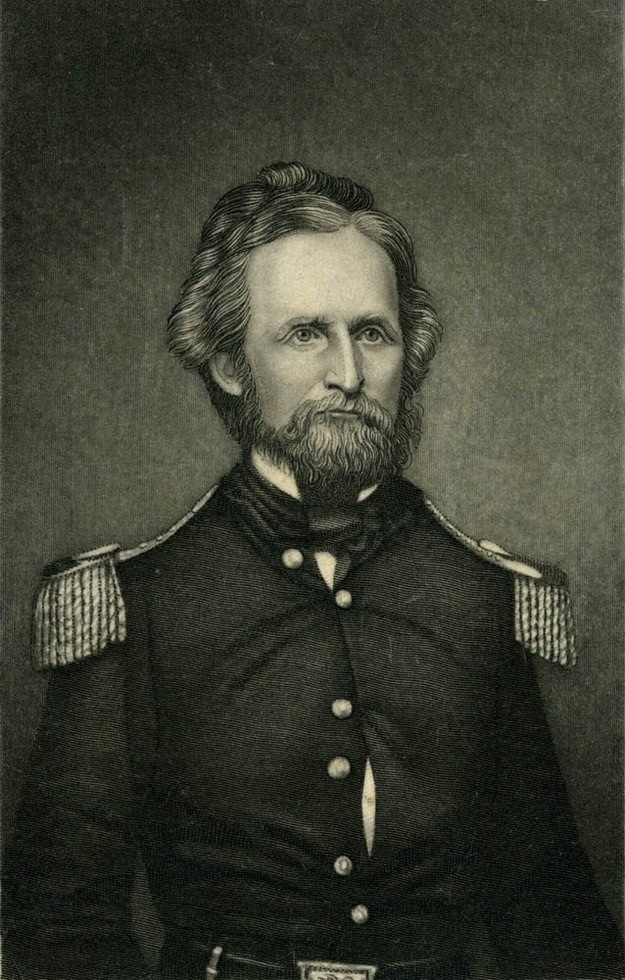
Union Captain Nathaniel Lyon was tasked with defending the arsenal alongside Frank Blair, an influential U.S. Congressman from St. Louis. They began raising their own pro-Union militia. It was composed of many German immigrants, and, through Blair’s influence, was sanctioned by the Lincoln administration. Teams of men began moving weapons out of St. Louis and into Illinois.
The inevitable clash of Confederate and Union forces at Camp Jackson finally happened on May 10, 1861. It was Missouri’s first skirmish of the Civil War. The camp, overrun by better-supplied Union troops, surrendered. Captain Lyon marched his new prisoners through the streets of St. Louis. The march only angered secessionists when they saw how many Union militiamen were German. Tensions escalated from slurs to knives and guns. An accidental shot by one of Lyon’s men into a group of civilians erupted into the killing of 28 people, including women and children, and injuring dozens more in what became known as the Camp Jackson Affair.

Despite simmering statewide resentment among many Missourians, Lyon was promoted to Brigadier General. He made clear his refusal to compromise with Missouri’s pro-secession leaders, declaring, “This means war.” His stance officially began the Civil War in Missouri and a march on Jefferson City to capture Governor Jackson.
Overrun, Governor Jackson fled the Capitol. Lyon’s federal troops occupied the city and quickly defeated the State Guard at the Battle of Boonville. Jackson and his forces retreated to southwest Missouri along with many of the convention delegates working nearby, leaving most of the state under federal control.
Jackson would spend most of the Civil War in exile. Meanwhile, a provisional state government was elected by the remaining delegates to the still-unresolved Constitutional Convention. Missouri would remain under two quasi-elected governments for the duration of the Civil War.