America celebrates 250 years in 2026. This post is the second in a three-part-series on the Civil War and Warren County’s experience. Read part 1 and Part 3.
The Civil War in Warren County did not arrive all at once.
The 1850 Census was the first to record a count of slave-holding families and their slaves in a separate schedule. Missouri had been contentiously admitted as a slave state in the Missouri Compromise, but it consistently held the lowest percentage of slave-owning homesteads with just 12-13% of white families owning slaves. Kentucky was second-lowest at 28%.
Warren County, along with families in the Missouri River “Little Dixie” corridor from Howard, Callaway, and Boone counties, were settled by many Kentuckian and Virginian families, bringing with them more affinity for slave ownership. In 1850, out of a population of 5,858, about 185-200 households owned at least one slave in Warren County, suggesting about 21-22% of free households had slaves. The number of German immigrant households with slaves isn’t known, but was likely extremely low. In the “deep south”, slave ownership was around 36-49% of free households.
By the 1860 Census, these numbers shifted considerably in places like Maryland which dropped to 12% and Delaware at just 3% slave ownership. Missouri and Warren County’s rates remained unchanged.

In the spring of 1861, when Lincoln’s call for troops spread through the small towns along the North Missouri Railroad, everyone sensed that the war would not be fought at a comfortable distance. The Civil War in Missouri was known as a “neighbor’s war”, where anyone with an allegiance, an opinion, and a barn or business was eligible to have their property burned.
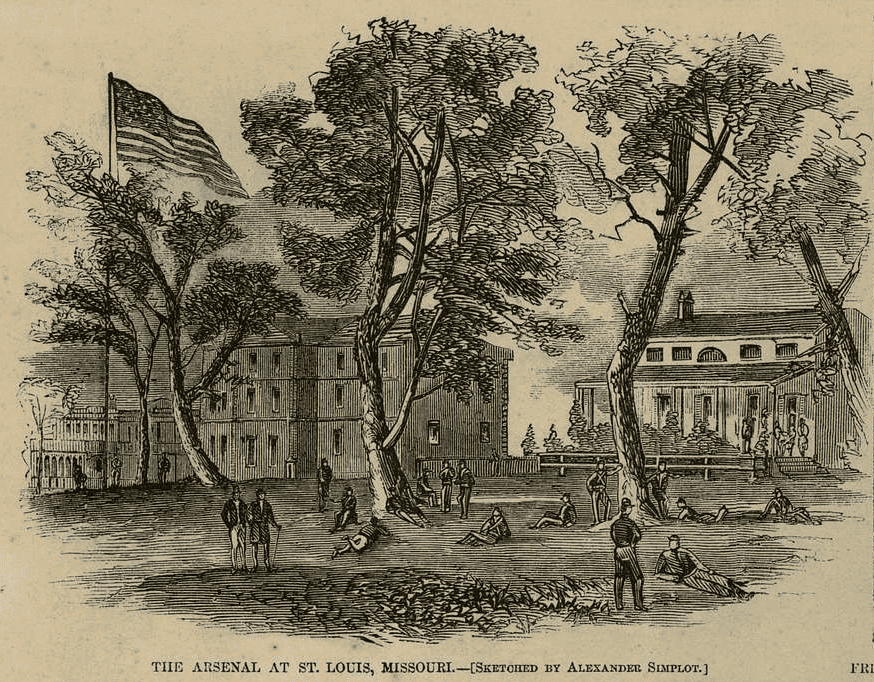
Warren County sat exposed near “the line of demarcation between the free States of Illinois and Kansas,” just a short ride from the Union Army staging grounds1 and its formidable St. Louis arsenal (today the campus is used by the U.S. National Geospatial Intelligence Agency). Unlike the American Revolution where as many as a third of people simply formed no strong opinion, neutrality was not an option in the Civil War. It seemed every man, woman, and child would have to declare themselves, where having no opinion meant having the wrong opinion. The arguments were not entirely about slavery, either. A 1925 view in the Warrenton Banner recalled,
“As the hope of armed neutrality dissolved, men were drawn to opposite poles. Relatively few Missourians fought either for slavery or for abolition. There were those whose conviction lay with the preservation of the Union; those whose belief was in taking a stand with their Southern kinsmen, and those who, doubly torn by these considerations, thought it best to save the state from invasion and internal war by staying in the Union.”
Warrenton leaned unmistakably toward the Southern cause. The county history notes that the majority of Warrenton citizens were firm believers in the doctrine of State sovereignty1.
For the few Unionists in town, life became a kind of quiet siege. Colonel Frederick Morsey, later to organize the Third Missouri Cavalry, was formally ordered to leave town by a band of prominent citizens, but refused. Described as “a man of courage,” he stayed, and went about his work in silence moving quietly through the streets of Warrenton to enlist more to meet at his house after nightfall 1. Slowly, a Union regiment took shape.
The first attack in Warren County during the Civil War
The first blow in Warren County was not inherently struck at any one man, but at a bridge. On an August night in 1861, a band of southern guerrillas rode openly through Warrenton just after sundown making no effort to hide themselves. They continued on to the Red Hill bridge along the North Missouri Railroad. Around midnight, they set the wooden span ablaze and waited, watching until there could be no doubt of its destruction before riding off2.
Secessionists hoped burning the bridge might slow Union regiments moving toward St. Louis. But the bridge was rebuilt quickly and did little to impede the flow of Union troops. The damage at Red Hill Bridge was a watershed moment confirming the war had unmistakably arrived in Warren County.
Some weeks before, a bloodier encounter had already played out just west of Foristell in St. Charles County along those same rails. In the days after the Battle of Carthage, word traveled quickly that a train carrying Union soldiers was moving west to reinforce General Franz Sigel. Confederate sympathizers spread out across the county, gathering men along the right-of-way. When the train reached a point just west of Foristell, a deadly volley of fire was opened upon it and did not let up for several miles as the train moved west into Warren County3.
Among those waiting was Thomas Edwards, son of a prominent Confederate family, who took cover behind a rail fence and waited for his moment. He was shot from the train and found later near a pond, three miles west of Wright City. He lingered for a day or two before dying. Fear of reprisal sent many of the attackers southward, slipping away at night and leaving their farms behind to join General Sterling Price’s army.
It was on a cold morning in March 1862 that the war in Warren County became a more personal affair. A man known in the county history as James Henderson, though a descendant would later give his name as Francis Gudere Henderson. The Henderson family’s backstory suggests Francis Gudere Henderson was born in Baton Rouge in 1826, moved to St. Charles after his father’s death, worked at a grist mill and as a printer, lost his wife and three younger children in a steamboat boiler explosion near Cairo, and then drew close to the Brisco family near Marthasville. The junior Henderson was remarkable for his height, standing six foot seven. He had come into the county to recruit for the Southern cause4.
He made little effort to hide his purpose, drilling men in the open near Marthasville and gathering supporters at the farm of Dr. Warner Brisco (sometimes spelled “Briscoe”). The Union militia had tried once to take him and failed, which only strengthened their determination.
On March 20, a detachment of about thirty men from the Third Missouri Cavalry set out from Warrenton, bound for the Brisco farm, three miles north of Marthasville. The county history gives only the barest outline: the house was surrounded, a demand for surrender issued, and the answer came in the form of gunfire from within5.
The Sanders family, drawing on memories and research at the old homestead, offers a more intricate account. Lieutenant Colonel Kiebel divided his men, sending half by the road, half through the woods to the north. Confederate lookouts on the hills caught sight of the road column and gave warning. Most of those inside the house managed to escape in a carriage, disguised in coats and bonnets provided by Jane Brisco, the doctor’s wife (Sanders). Henderson, though, was too large for any disguise. At three hundred pounds, no bonnet in the county could conceal him. He took up his gun and slipped into a bean field on the north side of the house4.
What follows depends on which account is believed. The county history records that the entire party was captured and Henderson was brought to Warrenton, where he died in a hospital a few days later.
The Sanders family’s version is more violent. A shot from within the house killed a young Union soldier (other accounts dispute the killing or are silent about it) and the militia fired back through the windows. Henderson, firing from the bean field, did not know that fifteen soldiers had come up firing from behind him. He fell at the base of the water pump behind the house. His son Beaumont escaped to a nearby barn and rode away on horseback. The father was carried to Warrenton, but did not survive.
For three more years, the war in Warren County dragged on. Wright City’s Baptist church and two other buildings in the autumn of 1863 were burned to the ground. Long columns of General A. J. Smith’s veterans continued marching eastward in the summer of 1864 to reinforce troops led by Ulysses S. Grant.((History of Warren County, 993)). And at the newly opened Western Educational Institute (later Central Wesleyan College), students took up guard duty beside townsmen, when a professor by the name of Van Dusen turned away foraging Union troops with a shout that would be remembered for generations.6.
Continue reading in Part 3
Or, return to Part 1, Warren County’s place in the Civil War
Additional context and sources provided by
- Simon, Mildred. “Civil War Divides Warren County.” Warrenton News-Journal, August 1987. Multi-part series.
- Simon, Mildred. “Civil War Skirmishes in Warren County.” Warrenton News-Journal, August 26, 1987.
- “Skirmish Fought, Volunteers Organized.” Warrenton News-Journal, July 23, 1995. 30th in a series.
- History of Warren County. In The History of Warren County, Missouri. Pages 989–996. Published c. 1880s. Warren County, Missouri. [↩] [↩] [↩]
- History of Warren County, 990 [↩]
- History of Warren County, 992 [↩]
- Sanders, J.D. “Writer Tells of Civil War Skirmish in Which His Ancestor Was Killed.” The Marthasville Record, n.d. Section B. [↩] [↩]
- History of Warren County, 993 [↩]
- Frick, J.H. “War Times.” In Commemorative Volume: Fiftieth Anniversary, Central Wesleyan College, 1864–1914. Central Wesleyan Bulletin XIII, no. 5 (September 1914 [↩]