
America celebrates 250 years in 2026. Years before Missouri statehood and Warren County’s formal establishment, Revolutionary patriots were bringing the promise of liberty and expansion west to the Missouri frontier.
This is the first in a series of stories celebrating America’s 250th year and local history.
The Revolutionary War veterans who settled in Warren County
Long before Gottfried Duden wrote exciting letters to friends back in Germany in 1824, and before Daniel Boone traced his path across America, there were a handful of brave patriots descended from a whole new category of Revolutionary legacy. A new, first generation of American veterans who became pioneers of expansion and wealth.
John Chambers emigrated to America from Ireland in 1767. He settled in Little York, Pennsylvania (today just York, a small town about an hour south of Hershey, PA), and for about a decade, quietly settled into Colonial frontier life.
In 1778, Chambers enlisted as a private in the Continental Army at the mature age of 391. Chambers could not have known that his decision — possibly driven by economic interest and a shared disdain for unrepresentative taxation — at 39 years old to shoulder a musket rather than remain on the edges of the Pennsylvania frontier, would one day carry him beyond the Mississippi River.

After the war, a cash-strapped Congress opted to pay soldiers with land. Many Revolutionary War soldiers would never see the land they were granted, some as far west as the Pacific. But their children and grandchildren might.
For men like Chambers, he, along with his son Thomas, moved to what would become Warren County, Missouri sometimes around the 1803 Louisiana Purchase — roughly three decades before the county was officially established (Warren County was then part of Montgomery County until 1833). Possibly just as the Spanish laid claim to Missouri and around the same time Daniel Boone settled around Femme Osage Creek. Since Spanish land grants weren’t issued at the time, Chambers was either a pioneer on the westward American frontier or a squatter on Spanish land, depending on his exact arrival. His exact migration path is not known, but may have moved west from Pennsylvania through southern Ohio and Indiana or northern Kentucky.
Burial and legacy in Warren County
Chambers’ son, Thomas, went on to later marry Eleanor Kennedy, the daughter of Thomas Kennedy, in St. Charles County in 1815. Thomas Kennedy was born in Bedford County, Virginia in April 1753 and also enlisted in the Continental Army.
Little did he know his final resting place wouldn’t be on a bloody battlefield in Virginia or New York, but in a small plot in Missouri.

The Kennedy family also tracked west after the war. First to Tennessee and then to Warren County in 1807, where the family established Kennedy Fort in 1810, helping guard against what settlers described as Indian raids during the War of 1812.
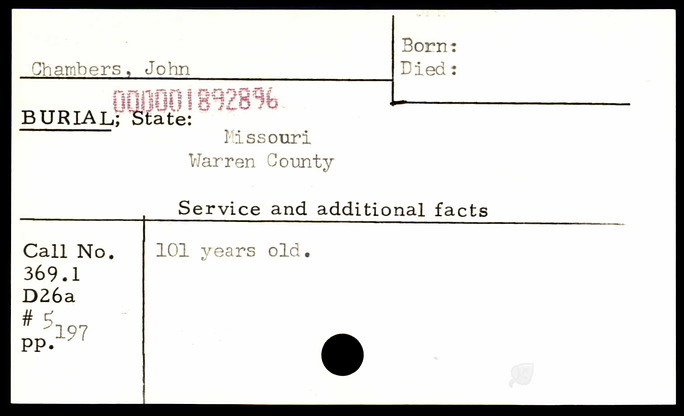
The Kennedy Burying Ground near Wright City is named for Thomas, who died at 70 in 1823. John Chambers lived another 18 years and died at the age of 102 in December 1841, and is also buried in the Kennedy Burying Ground2.
The “most precious parts of a state”
The December 18, 1914, issue of The Warrenton Banner has an early history of the county and includes this report about Kennedy:
Settlements in the central parts of the county date back to 1808. In that year Thomas Kennedy, a Virginian, was attracted by the remarkable tales of settlers who had returned from the far West, and he pushed westward to the wilds of Warren County. He settled just east and south of the present town of Wright City, and his descendants, still residing in that community, are among our most sturdy citizens. Major Kennedy was a soldier in the Revolutionary War. He escaped from his regiment when it was surrendered to the British through treachery. His experiences as a leader made him a valuable man among the little group of settlers, in that he planned well for their safety and welfare.
Several years after the settlement was made, Indian troubles arose, and it became necessary to erect a fort and stockade as a defense in case of attack. This fort was erected where the residence of Judge Royal Kennedy stood for many, many years, and where is now the home of Pleasant Kennedy, a descendant of the first daring settlers. Other early settlers who came to this community were Anthony Keller, of Pennsylvania; Samuel Gibson of South Carolina; and Daniel McCor and David Boyd of Kentucky.
The Chambers and Kennedy families lived extraordinarily long lives. These two men, one born in Ireland and one in Virginia, likely never imagined their travels, families, and relationships would extend so far and wide. Few Revolutionary War veterans lived to see the frontier they helped open become settled and organized. But these two lived long enough to see John Quincy Adams become president — a whole generation after the founders declared their independence in July 1776.
When Jefferson wrote to James Madison in October 1785, “The small landholders are the most precious part of a state,” he was talking about patriots like Chambers and Kennedy.
Most Revolutionary War land-grant recipients settled into the far reaches of Virginia or into Kentucky and Tennessee. But some braver families looked further west and settled only briefly in these territories before moving into the Missouri territory. They brought what they could fit onto the back of a horse or in a canoe.
A possible Daniel Boone connection
We don’t know why either Chambers or Kennedy moved into Missouri when they did. Records, news clippings, and files at the Warren County Research Library suggest four possibilities. One says they arrived January 1, 1808, and “had been attracted by the wonderful tales of settlers who had gone as far west as St. Louis, and returned to the eastern part of the country.” Another said they arrived in the summer or fall of 1807 at Daniel Boone’s Home. A third says they settled a mile and a half east of Wright City in 1809, but Wright City wasn’t founded until the 1850s. The fourth says that in 1809, the men left the women and children in the home of Daniel Boone to search for a suitable location. They selected a tract of 400 acres and, after the Indian Wars, settled on individual tracts of land. The Kennedys moved west from Tennessee, and the Boones from Kentucky, so it’s not known if they knew each other before they arrived.
We know thousands of Washington’s soldiers carried Revolutionary War Bounty-Land Warrants or pensions that established the foundations of generational wealth for children and grandchildren3 across the United States. When John Chambers died in 1841, his will bequeathed over $400 to his daughter Sarah, or roughly $15,000 in 2026 dollars, which bestowed significant buying power in then-early Warren County4.


Westward settlers also carried the Revolution’s ideals of land access, republican government, and personal liberty. When men like Chambers and Kennedy enlisted in the service of the Continental Army, a third of America still supported the Crown. A third favored independence. And a third, in that great American tradition, had no established opinion and were eager to profit off food, hogs, supplies, or other goods from whichever Army happened to march by. Chambers and Kennedy were not early entrants into the Revolution, but they clearly favored independence.
A “land of wonders”
Revolutionary War veterans like Thomas Kennedy and John Chambers fought for the ideals of the American Revolution and helped carry them into Warren County and they did so years before formal recognition of the space they called home. America exists today because of the Revolution. Warren County exists today in part because of how the Revolution transformed land, mobility, and what it means to be an American citizen.
The Revolutionary War formally lasted eight years from 1775 to 1783, but the process and progress associated with it endured for the next fifty years. When Alexis de Tocqueville wrote about his observations of America in 1835, he said, “The American lives in a land of wonders… everything around him is in motion.” Local settlers like Chambers and Kennedy were born subjects of a king and died citizens of a republic, looking coast-to-coast.
Research for this story was provided in part by Cathie Schippenhorst and Jerry Prouhet.
- SAR Index [↩]
- John Chambers in the U.S., Revolutionary War Burial Index, 1775-1875, Box #4 [↩]
- John Chambers in the U.S., Revolutionary War Pension and Bounty-Land Warrant Application Files, 1800-1900, Pension Year 1823, Archive Roll #509 [↩]
- John Chambers, Missouri, U.S., Wills and Probate Records, 1766-1988, Will Date: 1 Feb 1846, Probate Date: 6 Jul 1841 [↩]