America celebrates 250 years in 2026. This post is the third in a three-part-series on the Civil War and Warren County’s experience. Read part 1 and Part 2.
By 1863, the Civil War had left its mark on every household, making widows at a pace that defied belief. Across the border states, the German Methodist Church watched as its congregations thinned. Pews emptied by the loss of young fathers at Kirksville and Cedar Creek, at Chalk Bluffs and Rocheport, and in the nameless skirmishes that flared along the North Missouri Railroad.
Every month, young German fathers were giving their lives for the sake of a burned bridge or a boxcar of provisions in the name of the Union. The children who remained behind faced a future stripped of pensions, prospects, and, for many, even the language of the country in which they now found themselves. German Methodists resolved that caring for young children would be their task.
The organization that took up this work was, as a later exhibit statement described it, “an ambitious organization” whose “drive to develop an educated ministry was equaled by their desire to rear needy children with the Germanic virtues of strict discipline and hard work”1.
The German Methodists had already been running a dual-language college farther east, but the Civil War brought on what the commemorative history called “a sea of financial difficulties.” When the English department closed in 1863, the German school needed a new home2. In Warren County, they found nine hundred and forty acres of one.
When the Western Educational Institute opened east of Warrenton on October 3, 1864, the war was not somewhere else. Price was again in Missouri. Guerrillas had lately spread alarm north of the river. Students of the new school were already being called out with Warrenton’s citizens to help guard the town. The institution itself had been planted on the William Trusdail (now commonly spelled “Truesdale”) estate by German Methodists who meant not only to shelter fatherless children, but to keep their language, faith, and culture alive.
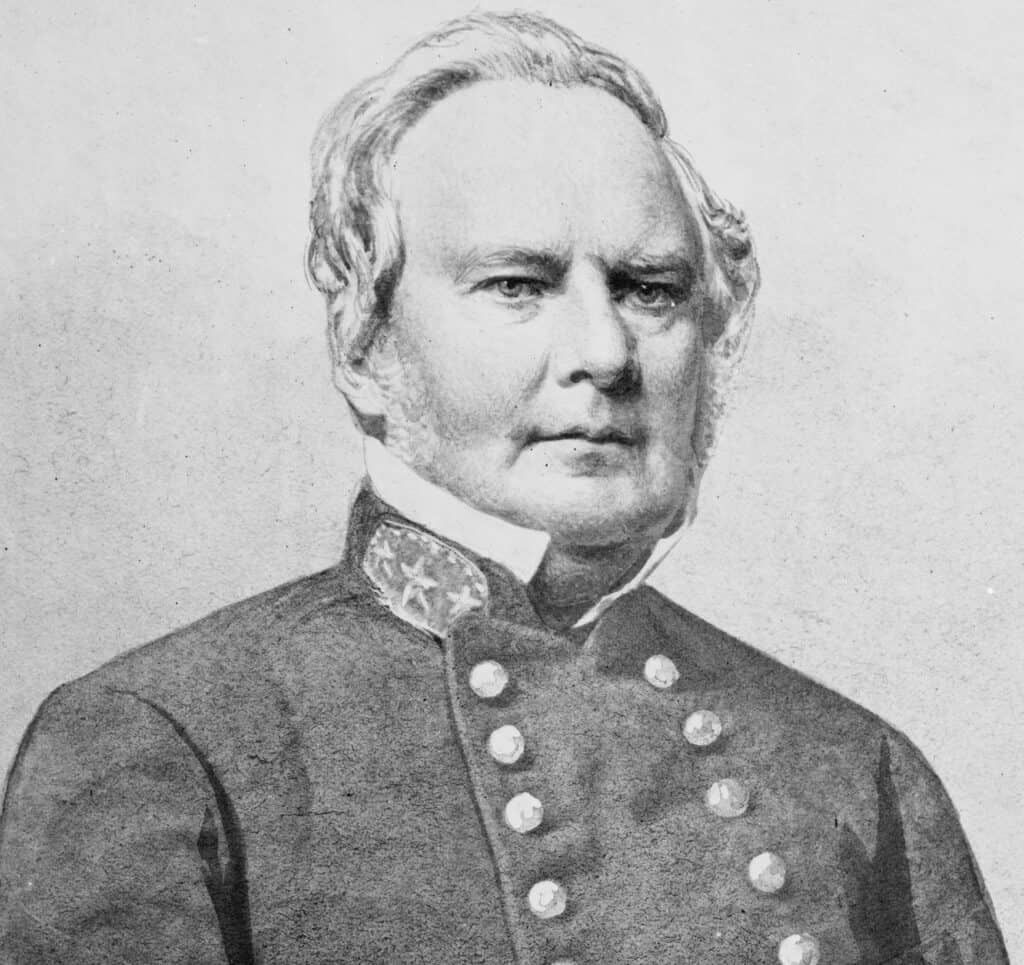
When the doors opened on October 3, 1864, the institution bore the name Western Educational Institute. The war, however, was far from finished. General Sterling Price, whom the students would later remember as ‘Old Pap Price,’ was even then making his final, prolonged sweep through Missouri. While guerrillas who had set fire to the courthouse at Danville in neighboring Montgomery County were, as student John H. Frick recalled in his memoir, spreading ‘consternation in the counties north of the river.’
The students themselves were not exempt from the uncertainties of the time. Frick remembered they were often summoned, alongside the townspeople, to help guard Warrenton.
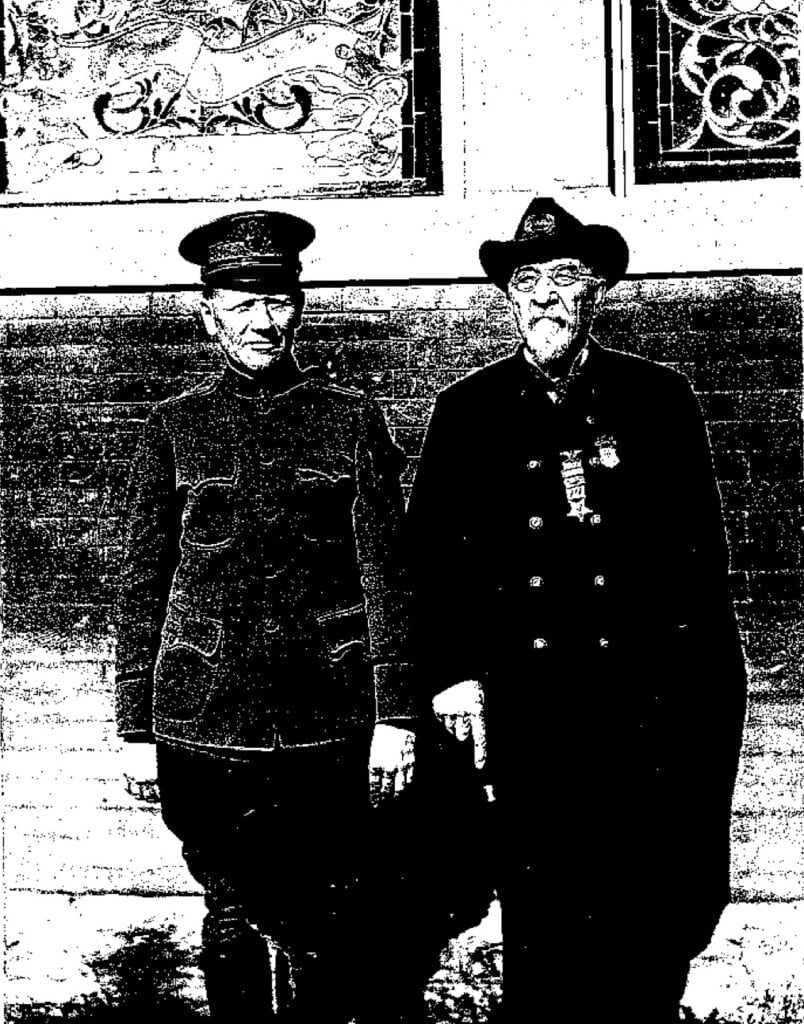
In the midst of these uneasy nights, students were posted on watch in the darkness. As Frick recalled, students “grew alarmed and cocked [a] musket, only to find, when the danger had passed, that [we] could not manage to release the hammer.”
Pope’s army camped at Truesdale in 1862. A.J. Smith’s men had also camped nearby in 1864. Once, when Union soldiers came foraging into Warrenton and spotted the cluster of campus buildings just east of town, they found the college kitchen and began ordering the cooks to feed them, demanding they “be quick about it”3. It was Professor Van Dusen who intervened. His words, preserved in Frick’s account, must have echoed through the whole campus: “What do you want? This is no n— plantation; This is an Orphan Asylum! Get out!”4.
Mildred Simon, writing in the Warrenton News-Journal in 1987, recorded a later episode in which a troop of United States soldiers visited the orphans’ home during the final years of the war. Professor Van Duzen (she spells his name differently) again told them it was not a plantation but an orphanage. The soldiers, she wrote, ate anyway, “saying that they were hungry and were orphans also”5.
Decades later, the Reverend C.F. Schlinger, superintendent of the home, discovered a claim against the government filed by “Papa” Kuhl. Reverend Philip Kuhl, the first president of the campus, sought compensation for losses caused by U.S. soldiers. Whether any payment was ever made, Simon noted, remains unknown6.
Among the first students were men who already knew far more about war than any professor could teach them. Frick remembered that “a number of the students had been Union soldiers, and continued to wear their uniforms while attending college”3.
Some of these young men had served alongside the very Warren County soldiers whose names fill the regimental rosters. The Wegners and Veiths and Schoenbaums of the Third Missouri Cavalry, and the men who had fought at Briscoe’s Farm and had been captured at Cedar Creek.
“Some wore an empty sleeve or showed in other ways their maimed condition,” Frick wrote. “Joe Burger was one of these and could tell the boys war stories till their hair fairly stood on end”. Lieutenant Hummel, who had lost a leg, lived down the road in Truesdale. Captain Grenzenberg, later of Cincinnati, spent part of a school year in a room “in the old Red Building.”
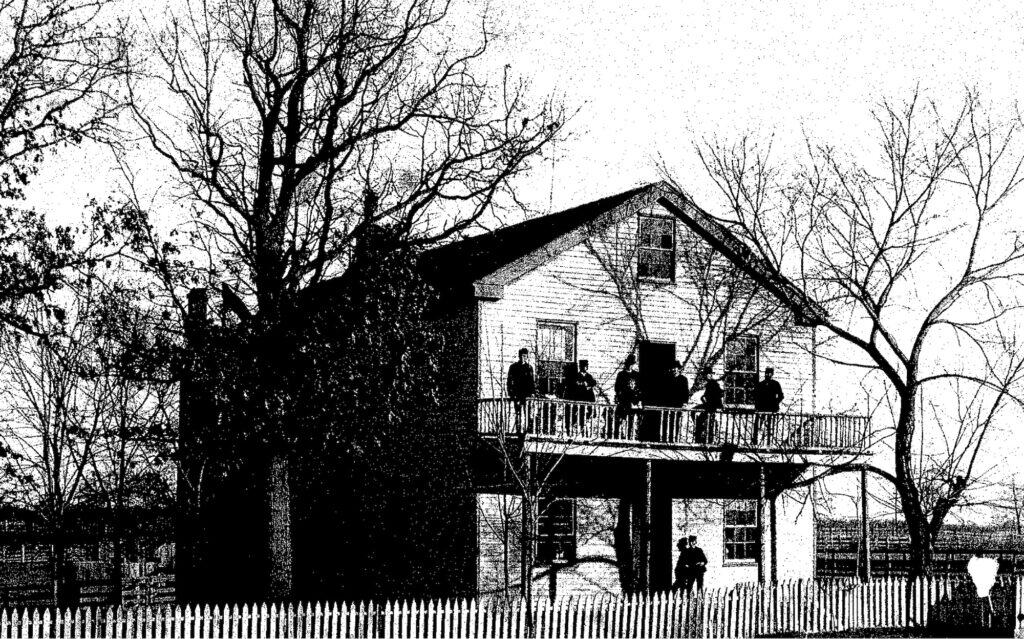
Into this atmosphere, part barracks and part seminary, came Christ Hildebrandt, a student from Freeport, Illinois, who carried tall sycamore poles from the Charrette Bottoms, spliced them together, and raised the American flag over the campus for the first time.
The German immigrants of Warren County, as the county history would later record, had been conspicuous in their devotion to the Union cause. Their sympathies lay overwhelmingly with the North, and now, in the midst of war, they and a group of German Methodists set about building something intended to endure beyond the conflict.
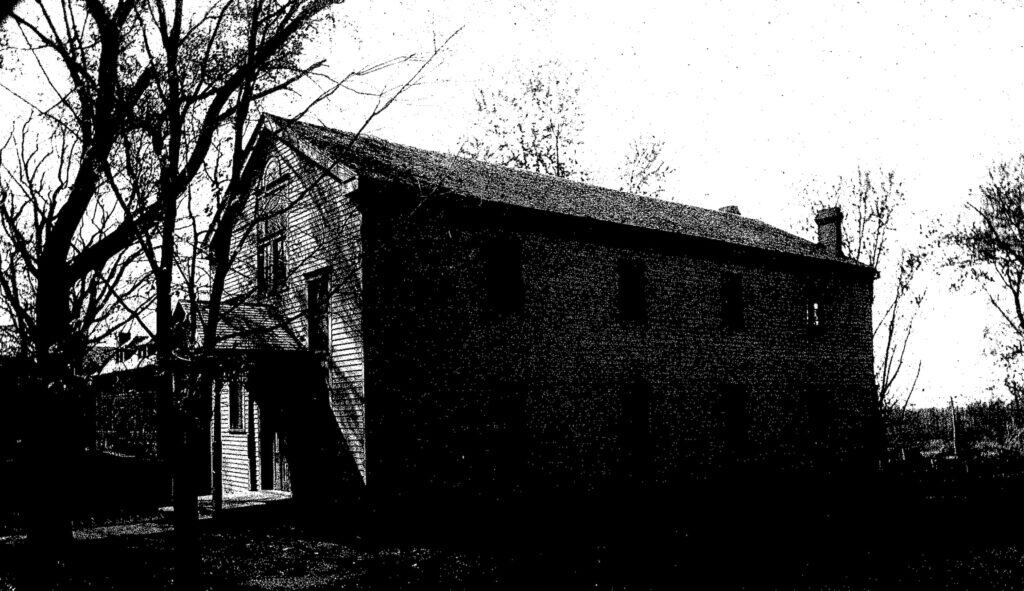
Frick himself first came to remember the institution both as a prisoner of war and as a student. Along with Samuel Weber, Henry Weber, and John Irminger, he had been captured at the Battle of Glasgow, Missouri. Paroled and sent home by train, they paused at Truesdale for breakfast. It was there over breakfast, through the window, that Frick overheard a fellow soldier mention that ‘Unsere Anstalt’ (“our institution”) stood nearby.
Fifty years later, Frick would recall that none of them could have imagined that this place would become his former school and the center of his life’s work.
By the close of the war, Warren County had sent its sons to both armies. People of some experience and some self-knowledge know that the contest between right and wrong is perennial in the soul of every human, and that right and wrong cannot be geographically divided and is often hard to discern. Rational people also recognize that southern racism or warfare is not categorically worse than northern racism or warfare. During the Civil War, some people were living in the South who were opposed to slavery and secession, and some people were living in the North who sympathized with the South. Border states showed how blurry geographic boundaries truly were. The German immigrant families—the Wegners, the Veiths, the Schoenbaums—had almost all chosen the Union. The older Anglo-Southern families—the Stewarts, the Kents, the Kennedys—had mostly gone with the Confederacy.
Neighbors who had lived side by side for years found themselves, as one county historian put it “with quiet understatement, suddenly in a position where to hold an opinion meant to act upon it”7. The old hostilities, history tells us, were eventually laid to rest. But those who fought and sacrificed at Red Hill bridge, at Brisco’s farm, at the rail fence near Foristell, and scattered across hundreds of other battle sites in the southern states remained where they had fallen.
- Adams, Laura. “CWC Main Theme Statement.” [↩]
- Central Wesleyan Bulletin, 1914 [↩]
- Frick, 1914 [↩] [↩]
- Frick, J.H. “War Times.” In Commemorative Volume: Fiftieth Anniversary, Central Wesleyan College, 1864–1914. Central Wesleyan Bulletin XIII, no. 5 (September 1914 [↩]
- Simon, Mildred. “Civil War Skirmishes in Warren County.” Warrenton News-Journal, August 26, 1987. Seventeenth in a series. [↩]
- Simon, Mildred. “The Civil War Divides Warren Countians.” Warrenton News-Journal, 1987. Multi-part series. [↩]
- History of Warren County. In The History of Warren County, Missouri. Pages 989–996. Published c. 1880s. Warren County, Missouri. [↩]