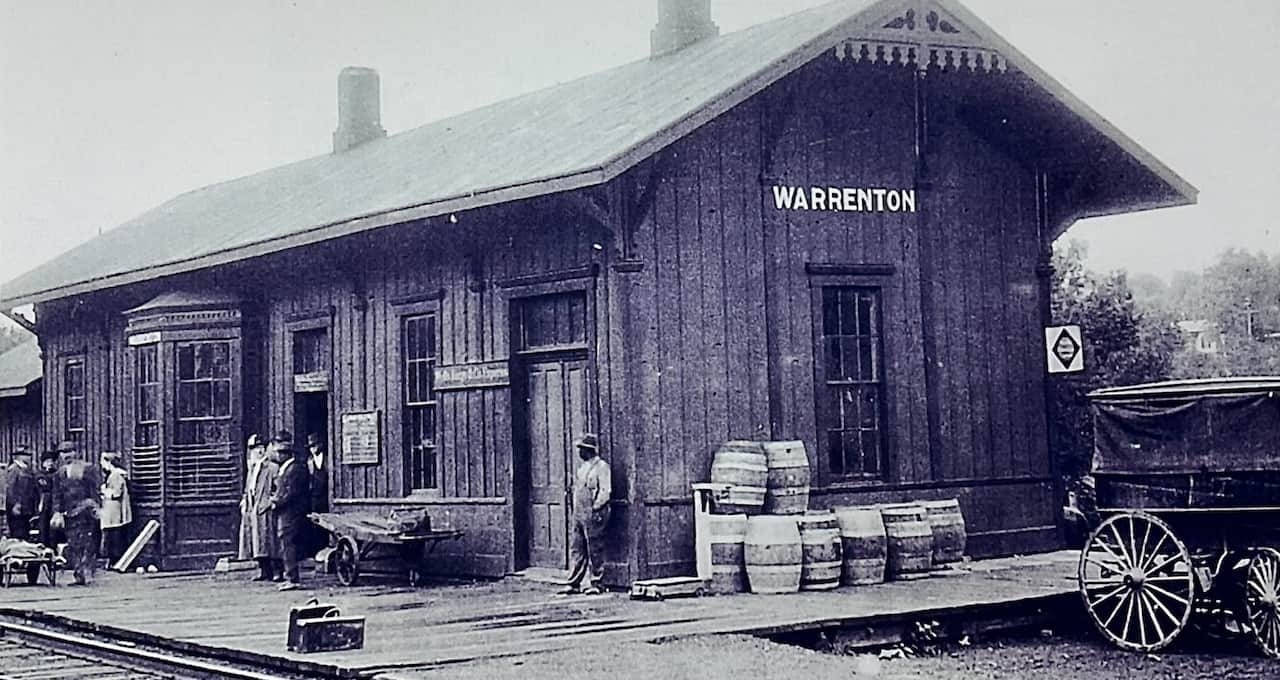
America celebrates 250 years in 2026. At the start of the American Revolution, Abigail Adams wrote to her husband John as he worked with the young Congress on a Constitution, to “remember the ladies”. John’s response to her was terse and scoffing, but of his time and place. As America celebrates 250 years of independence this year, we look at some of the remarkable women who have not been forgotten in Warren County’s rich history.
Three generations of Schowengerdt women
Elesebet (Elise / Elisabeth / Elizabeth) Schowengerdt (abt 1821 – 1886)
The stately and beautiful Schowengerdt house in Warrenton was built in 1866 just after the Civil War by Ernst Schowengerdt for him and his wife, Elesebet Hukreden (often found in records as Elise, Elisabeth, or Elizabeth). They moved into the home in 1870.
Ernst was a German immigrant who came to America when he was 13 with his mother and two sisters. One of his sisters would die of cholera in New Orleans. The rest of the family came north to Missouri, inspired in part by Gottfried Duden’s writings to the Rhineland of the area.
The Schowengerdt home housed three incredible Schowengerdt women who worked to make a private home into a public showpiece. At the time it was built, the brick Missouri-German home was in the classical revival style of the time. The original National Register nomination records that Ernst worked for area farmers doing odd jobs and seasonal work. He saved enough for an axe, then cleared land and established his own farm on Dry Fork Charette. He married Elesebet in 1844 and within a year Elesebet gave birth to their first child, Johann William (1845-1912).
Somewhat invisible to the era, Elesebet reared children, farmed, and was no doubt the true pioneering force behind the family’s transition from wayward immigrants to established residents and, eventually, owners at Warrenton’s most important general store.
In 1866, the Schowengerdts lived in a small house next to where the large house was being built. The Warrenton General Store opened in 1867 about two blocks from their home at the intersection of Boone’s Lick Road and Market Street. Like most stores of its era, the Schowengerdt Store primarily served the needs of farmers with items they couldn’t get grow or produce themselves, like sugar, tea, salt, and often clothes or advanced tools.
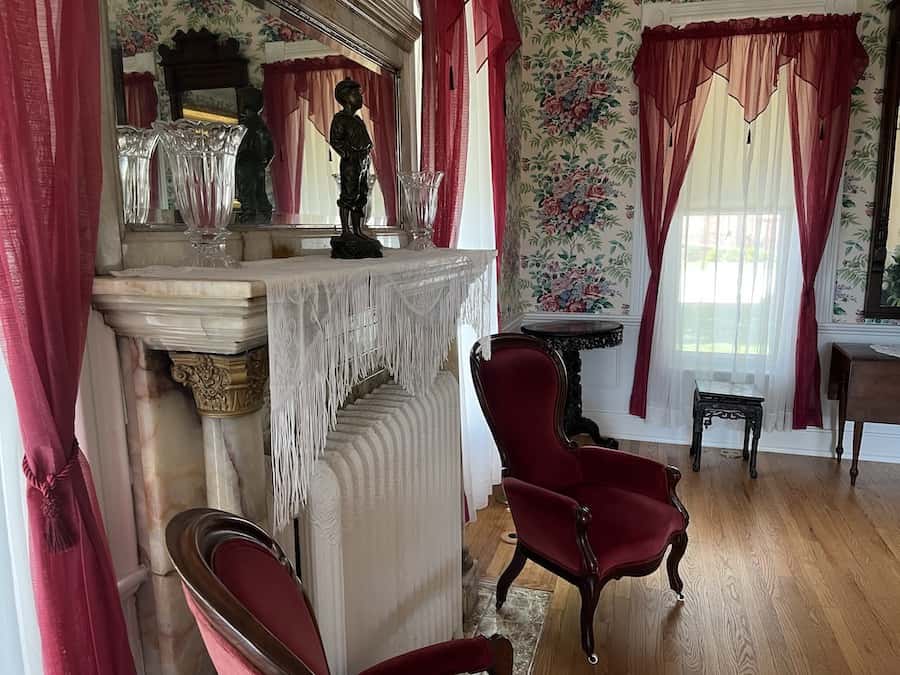
The home Ernst and Elesebet built remained in the Schowengerdt family until their granddaughter Margaret Carol’s death in 2002, when it and its gardens were transferred to the Warren County Historical Society through a trust. The home was added to the National Register of Historic Places in 1980. Ongoing maintenance was done from 2003 until 2020 when a comprehensive restoration of the home was begun. A grand reopening of the home was held, December, 2021.
Laura Wightman Schowengerdt (1869-1961)
As the family aged and generations turned, Elsebet’s son, Franklin, married Laura Wightman. Talented in art, Laura was born in St. Louis where she later studied under the tutelage of a St. Louis art teacher. Many of her oil paintings have hung in the Schowengerdt home, and remain on display today.
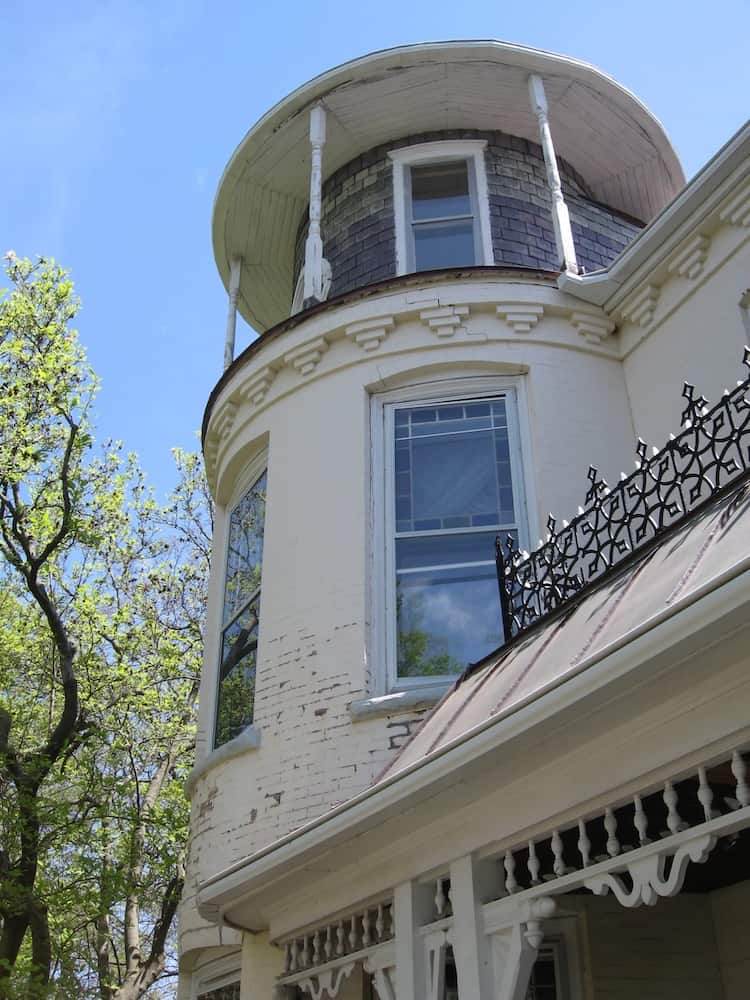
The Schowengerdt home had its first transformation when Franklin added Queen Anne features, which are still visible at the home today. The round tower and Eastlake-style porches blends an interesting architectural history around 1892.
An August 27, 1937 Warrenton Banner news story on Laura and Franklin’s gold wedding anniversary reads in part:
Mrs. Schowengerdt’s ancestors are the Stokes and Wightmans of England, and the Smiths and Griffiths of Virginia and Kentucky. She is interested in garden club work, was one of the organizers of the Warrenton Garden Club, and was recently appointed State Chairman of Program and Lectures Committee for the Federated Garden Clubs.
Laura Wightman Schowengerdt helped organize the Warrenton Garden Club in 1930, established citywide landscaping and beautification efforts, and later became an honorary life member of the Federated Garden Clubs of Missouri. Her love of gardening is visible today on the grounds, which over time has featured century-old ginkgo, hundreds of varieties of shrubs, trees, and flowers, and other perennials.
Margaret Carol Schowengerdt (1901-2002)
Margaret Carol, a schoolteacher, died in 2002 and was the descendant responsible for preserving what Elsebet, Laura, and the rest of the Schowengerdt family built. The third generation Schowengerdt, Margaret Carol was an active leader in public education. The December 9, 1948 Warrenton Banner featured a small report of her early career work:
Miss Margaret Schowengerdt, form President of the Webster Groves Classroom Teachers Association, attended a two-day conference sponsored by the Department of Classroom Teachers of the National Education Association at NEA headquarters in Washington, D.C during the Thanksgiving holidays. Thirty states were represented. On December 3 and 4 [she] attended the South Central Regional Conference of the Department of Classroom Teachers at Little Rock.

Margaret Carol was also an active member of the Warren County Historical Society. She helped edit the county history, and gifted the house to the Historical Society for public preservation as it remains today, down to the gardens cultivated by Laura and the homestead established in part by Elsebet. The Schowengerdt House in Warrenton is preserved today in no small part to the family trust and trust she placed in the Warren County Historical Society to preserve and maintain the home for the public good. Tours of the home are available and feature a look inside “Margaret’s room” and the home’s gardens and architectural history.
Pioneer mother Sarah Gibson Kennedy (1774-1857)
Sarah Kennedy appears in the first deed entered in Warren County’s deed records. On January 25, 1833, a mere twenty days after the Missouri Legislature created Warren County from part of Montgomery County, Guyon (sometimes “Guion”) Kennedy and his wife, Betsey P. Kennedy, of Lincoln County, executed a deed conveying 160 acres to Sarah Kennedy of then-Montgomery County for $640.
The land was described under its older jurisdiction as lying in Montgomery County: the southwest quarter of Section 13, Township 47 North, Range 2 West. The deed was later acknowledged and filed for record on August 6, 1833, by Carty Wells, Warren County’s first recorder.
Her father Guyon Gibson came from Duck River, Tennessee, settled in what became Warren County in 1810, and had children including Sarah, who married Revolutionary War veteran Major Thomas Kennedy. Sarah Gibson Kennedy stood at the center of two early Warren County families. Sarah mothered 16 children (nine boys, seven girls). The Kennedy family, along with the Gibson family who themselves had 17 children (thirteen boys, four girls) established such large families they constitute a considerable lineage of descendants all intertwined from the county’s earliest days near Wright City. Read more about the Kennedy-Gibson families.
Rebecca Ann Bryan Boone (about 1739-1813)
Often overshadowed by her husband, Daniel, Rebecca Bryan Boone became the first burial at the Bryan-Boone family cemetery on a knoll above Tuque creek.
Born either in January 1738 or 1739 in Virginia, Rebecca’s life was mobile, even by the Quaker standards of the time. Her family moved to North Carolina around 1749, and she married Daniel Boone in 1756.
The Boones and Bryans lived near each other in North Carolina and many intermarried. Much of the Boone family is steeped in lore, but one account suggests Daniel first met Rebecca at the wedding of Daniel’s sister, Mary, and Rebecca’s uncle, William, in 1755. Daniel and Rebecca supposedly married a year later with Daniel’s father, Squire, performing the ceremony in his role as Rowan County Justice.
A pioneering woman in her own right, she founded homesteads in North Carolina, Virginia, Kentucky, and finally in Missouri near Marthasville. Carlynn Trout wrote in her book, Notable Women of Missouri, that:
Clothing her family was also a major operation that involved many steps. She grew flax and cut wool from her herd of sheep to spin, dye, weave, and finally sew into clothing. Since Daniel, and later her sons, wore buckskin when hunting, she knew how to skin, tan, and prepare hides for clothing, too. She made candles and soap, chopped firewood, and also knew how to make bullets and shoot a gun.
Daniel Boone might have been the pioneer legend people remember, but it was Rebecca that did the work of making the family of ten (six sons, four daughters) portable. Their household expanded as Daniel took in children from close relatives who died.
When Daniel was scouting in Kentucky, Rebecca stayed behind in North Carolina. When the family eventually began moving west through the Cumberland Gap in 1773, their son James Boone was killed and the party turned back.
Two years later, Daniel was hired by the Transylvania Company to cut the Wilderness Road into the Kentucky territory. Rebecca and the family later joined him near Boonesborough. In an early bit of public-private interstate debate, the Transylvania Company promised 2,000 acres to the Boones. But the claim to this land was never validated by Virginia and out of control speculation drove the company to ruin. Then, during the American Revolution, Daniel was captured by the British-backed Shawnee on a salt-seeking expedition in 1778. He later escaped and warned residents of Boonesborough, which had been repeatedly targeted by the British. It is believed some residents thought Daniel betrayed the colony to the British.
During the American Revolution, Rebecca returned to North Carolina from Kentucky, under the assumption he was either dead or lost. After the Revolution and Daniel’s return, the chaotic land system in Kentucky drew him into a series of expensive, unsuccessful lawsuits. The earlier Boonesborough settlement and its 2,000 acres were never validated or recorded, and a series of title errors and debt extended into the 1790s. A warrant for his arrest was issued in late 1798. In 1799, the Spanish Governor of Louisiana granted Boone and his son, Daniel Morgan, land at Femme Osage, near the Missouri River. The Boones ultimately fled to Spanish-held Missouri to avoid years of failed land claims, lawsuits, title defects, unpaid taxes, and other debts.
It would take an act of Congress to eventually grant relief after the Spanish title was deemed invalid, too, as land and titles continued to shift in the changing American landscape. Such was life for a frontier family on the bleeding edge of American expansion. Without Rebecca Ann Bryan Boone carrying the entire household west, the entire family’s sustainable, livable existence could never have happened.
Jemima Ann Boone Callaway (1762 – 1834)
Jemima Boone Callaway is the daughter of Daniel and Rebecca Boone, born in 1762 when the family still lived in Rowan County, North Carolina. She followed the family’s footsteps through several states before her parents fled into Missouri. It’s Jemima that anchors the Boone family in Warren County’s history. Marthasville’s town history notes Daniel and Rebecca Boone spent most of their final years living with Jemima and her family.
She is best known as the daughter captured by men in Kentucky. According to the Kentucky Historical Society, Jemima and the Callaway sisters, Elizabeth and Frances, were canoeing on the Kentucky River when they drifted close to a riverbank, were captured by five Native American men, taken north, and later rescued by Daniel Boone and eight other men.
Smart and capable, Jemima delayed their captors, stalled horses by being purposefully thrown, and left signs like broken branches, berries, and leaves so their families could follow.
After her rescue, she married Flanders Callaway at Boonesborough. Her capture made a name for Jemima, but not long after in 1778, she and other women at Boonesborough Fort put on men’s hats and clothes in an attempt to make the fort look more well-defended than it really was. She loaded Daniel’s rifles, molded musket balls, recast spent bullets into new ones, carried hot bullets in her apron, and put out fires started by flaming arrows.
When the Spanish offered the Boones a sort of asylum in Missouri, she and her husband along with much of the family headed west to the junction of Charrette Creek and the Missouri River, close to the original French village of La Charrette (near present-day Marthasville). She and her husband built a house around 1812 in one of the first Warren County settlements. The house functioned as a home, trading post, and fort.
In the later years of Daniel and Rebecca’s life, they spent much of their time living with Jemima, giving credence to Warren County as “the last home of Daniel Boone.” The Callaway House was moved to St. Charles County and remains among the oldest and most historic sites in the region.
She died August 30, 1834 in Warren County. She is buried at the Old Bryan Farm Cemetery in Marthasville.
Mary W. Mellemyer Addicks (1862 – 1936)
Born October 17, 1862 during the Civil War, Mary Wellemyer (some records record her surname as “Mellemeyer”) grew up surrounded by books and education. She was formally educated at Ames (later Iowa State) and Iowa Wesleyan University, making her one of the rare women to attend higher education in the 1880s. She taught in Iowa public schools, too, all before marriage. The 1895 Portrait and Biographical Record of St. Charles, Lincoln, and Warren counties describes her as Mary W. Wellemyer of Garner, Iowa, “a lady of many accomplishments.”
The Ames, Iowa University was one of the new land-grant institutions that operated with a broad promise to education regardless of age, income, or gender. Women were part of its first class. One early family history (PDF) shares that Mary’s early ambition centered around teaching. After Ames, she attended the German College in Mount Pleasant, Iowa, where she met George B. Addicks, a young professor of German.
Her marriage into a German Methodist education and world of faith moved Mary into the role of presiding over the parsonage home at the First German Methodist Episcopal Church in Pekin, Illinois. Then, in 1889, George became professor of Practical and Historical Theology at Central Wesleyan in Warrenton. He was promoted to President in 1894.
Like Ames, Central Wesleyan taught male and female students. Its 1895–1896 catalog (PDF) said students of both sexes were “admitted to all courses, maintained a Ladies’ Home, and supported Philomathia”, a society organized to give young women literary and parliamentary skill. Mary was never a named staff member at Central Wesleyan, but it’s doubtful she didn’t play an integral role in the lives of many young men and women around the campus.
Her husband died in 1910. Mary lived as a widow for another quarter century before dying May 31, 1936 in Webster Groves, Missouri. She is buried in Warrenton.
Nellie Jewel Owens Ruge (1913 – 2010)
Nellie Jewel Owens Ruge was born in 1913 when Wright City was still a small railroad community. As a child, she watched her father go to work every day as a railroad section foreman. She graduated from Wright City High School in 1931 as part of the school’s first graduating class (PDF). “Before I got out of eighth grade [Wright City] established a two-year high school. People who wanted to go longer than that went to Warrenton. The year I was in 10th grade they went to a four-year high school, so I was able to graduate from Wright City High School in 1931,” she recalled to a Warrenton Journal reporter years later. In another report, she recalled enjoying mathematics courses and, despite Wright City not having many classes at the time, she opted to take a new typing class with manual typewriters.

Almost immediately after graduating, she began working at Farmers & Merchants Bank, earning $30 a month (a future raise brought her to $32.50/month, or a little more than $660 in 2026 dollars). At the time, the bank had only a few hundred accounts with every dollar held behind a single vault, and it all existed in a time before the FDIC and other banking protections.
During the Great Depression, the bank was one of the few that survived, both regionally and nationally while many financial institutions across the country failed. FMB Bank’s history notes that it was “the only bank in Warren County to survive the Depression without reorganizing, renaming, or selling out, providing continuity for local families and businesses during one of the most difficult economic periods in American history.”
Nellie met her husband, Corwin S. Ruge while they worked at the bank. Corwin’s family had a stake in the Farmers and Merchants Bank. A 2000 Warrenton Journal interview recorded, “On the first date I had with him he said, ‘I’m going to marry you.’ And I said, ‘Oh yes?’ Shows what I knew. We got married in ’34.”
Corwin Ruge later became bank president. After his death in 1971, Nellie had been with the bank for 40 years and she assumed the role of bank president that same year until 1995. She continued as Chairman of the Board until her death in 2010 at the age of 97. In total, she invested 64 years of her life with the bank.


Her remarkable career was both long and stable in a time and industry dominated by men. Under her leadership, the bank modernized multiple times from a small local bank to part of a global, digital banking age.
She was named Wright City Person of the Year in 1995 and Warren County Business Woman of the Year in 2004. Today, Farmers & Merchants Bank simply goes by FMB Bank and is the oldest operating bank in Warren County.
Special thanks to the family of Nellie Jewel Owens Ruge for the provided photos.