
Seventeen days after the armistice of World War I, on the evening of Thanksgiving, 1918, a group of Warren County farmers gathered to hear from nine Franklin County farmers who crossed the Missouri River. The Warrenton Banner described the weather that Thanksgiving evening as “very unfavorable.” Why they met on Thanksgiving evening is unknown, but it’s plausible it was just the first available evening everyone could be counted on to not be working.1,2
The Banner reporter who attended the gathering called it “quite a successful meeting,” in spite of the heavy rain and wind. What the Franklin County farmers said is unknown. But we can infer that since all the farmers present joined a Farm Club, whatever was said met with unanimous approval of at least a dozen people in the room. Otto Nienkamp was elected president, Chas. Koch vice president, and Hugo Hasenjaeger secretary and treasurer. They agreed to meet again on Saturday, December 7, at two in the afternoon.1
The need for allied food
For four years, World War I drew down on American farm production. At a time when mechanized industrial agriculture was still largely unavailable or prohibitively expensive, horses and mules plowed American farms to help meet the need for food. Federal guarantees for wheat and hogs helped support prices as farmers were urged to produce more.
The complicated economics of increasing production brought the risk of price collapses. Too much production meant a glut of goods. More labor would be needed precisely as more young boys were drafted into Europe, which meant higher labor costs. Something the war had already doubled in costs. National Bureau of Labor Statistics put the average monthly cost for hired farm labor at $25.13 in 1914 and $51.13 in 1919. European production turned toward war needs, which meant other commodity household products cost more, even in America.2,3
Higher prices and guarantees for a crop didn’t necessarily mean higher wages or profits for farmers, either. For most Midwestern farmers, the war was an untenable economic situation of increased demands, costs that were 2–3x higher in the span of just a few years, and stagnant or declining profits due to fixed-price purchasers, mostly the government. Other challenges were apparent, too, like the lack of rural educational opportunities.
The problem of scale
There was the old problem of scale, too. Treloar, Missouri, had a railroad and its grain and livestock could reach markets beyond Warren County. But access to the tracks gave a lone farmer little control over what supplies, feed, or fertilizer cost to produce or what they could fetch on the market.
William Hirth, the publisher of a Missouri farm paper, believed farmers could change the terms by working together. His own paper’s masthead called for “production cost and a reasonable profit for the farmer’s sweat and toil.”5 Hirth imagined farmers purchasing coal and fertilizer in quantity, assembling livestock for shipment, and finding a stronger position in the market. The leadership for such work would have to grow from the countryside itself, for, as he wrote in 1917, “true leadership comes from the bottom, and not from the top.”6
Seven farmers in Chariton County had put the principle to a modest test in 1914 by pooling an order for 1,150 pounds of binder twine. A later published account estimated the farmers saved about $400 (about $13,500 in 2026 dollars)7, which was then used for contracting coal, flour, and mill feed at wholesale prices. With savings and power like that, the movement grew as farmers banded together.8,9
Across the Missouri River in Franklin County, the movement had acquired a life of its own. Farmers were forming clubs school district by school district, often using the schools themselves as convenient meeting locations. The Republican Headlight reported in March 1917 that one group near Clover Bottom enlisted twenty-four members in its first evening and another at Krakow enrolled twenty-two. An Oak Grove club had already pooled an order large enough to fill a railcar with farm supplies. By late 1918 the county association claimed to speak for more than 1,600 club members. The Franklin County clubs had something practical to show the Treloar farmers and their neighbors in Warren County.10,11,12
Even the best way to organize was under discussion. On November 23, just five days before Treloar’s meeting, farmers gathered at the Union courthouse to consider forming a county Farm Bureau. A leader of Missouri’s farm clubs argued that the two kinds of organization could work together, while Hirth soon publicly objected to the Bureau campaign in Franklin County. The local papers carried the disagreement as farm-club delegates prepared for their own county convention. There is no evidence that the men who visited Treloar spoke about the dispute. Their trip took place, however, amid a spirited argument over how farmers could best make themselves heard.13,14
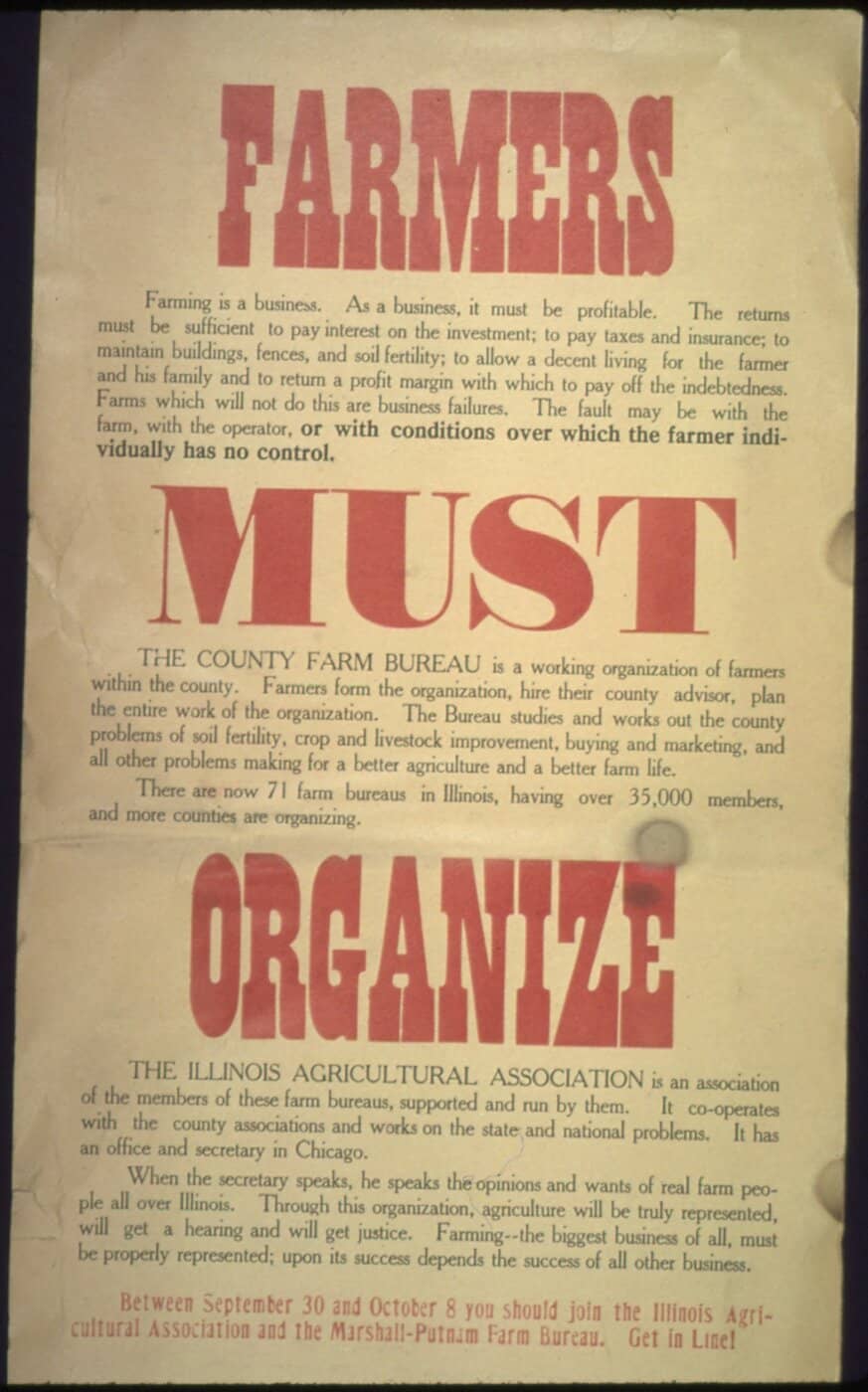
Warren County was the first county in the state to establish a county-wide farm club. Smaller individual clubs combined to form the Warren County Farmers Association in 1915. The Treloar Farm Club was instrumental in the formation of clubs in Peers and Marthasville, and the Tri-County Farmers Association composed of Warren, St. Charles and Montgomery counties.16
The State Historical Society of Missouri counts 500 farm clubs by July 1916, and the statewide association had been formed by early 1917. Some Warren County farmers were already organizing when their Franklin County visitors came to Treloar on Thanksgiving night. Each man’s reasons for attending are left unreported, but the advantages their visitors came to describe were well known.17,18,19,16
A year of work
Within a year of Warren County’s first club, The Marthasville Record reported that the new New Haven Farm Club had shipped a carload of cattle to St. Louis. It’s likely other shipments from the region’s farmers were collected together, but this is the only surviving report of a specific shipment.20
A notice for the first annual meeting, scheduled for December 6, 1919, called for the election of officers under a constitution and bylaws. It also announced a debate on Missouri’s compulsory school law and welcomed farmers from neighboring districts.
The values of the Treloar Farm Club extended beyond farming to the need for high schools. The Treloar Farm Club, whose members envisioned a rural high school that would “grace our hills, giving our boys and girls and equal chance with the city youth in the great battle of life.”16
Hugo Hasenjaeger signed as secretary, just as he had been chosen to serve at the founding.21,16
Continued economic shifts
The economic world around the farmers kept shifting. Farm prices remained high into 1919, then fell sharply in 1920 as demand from overseas receded. Across the country, the average price farmers received for wheat dropped from $2.16 a bushel in 1919 to $1.03 in 1921. In 1921, the Record was still reporting livestock shipped to St. Louis under the Treloar Farm Club’s name.2,22
Costs doubled, then prices halved
Average monthly wage for hired farm labor
Average price farmers received for wheat, per bushel
Bars are drawn to scale within each chart. Wages: U.S. Bureau of Labor Statistics.3 Wheat: USDA Economic Research Service.2
Local clubs continued to pool together. Today we would call farm clubs “co-ops” or an “exchange,” and many of the early farm clubs have evolved in name, but not in their intention and purpose. The clubs were valuable well into the depression, and helped finance grain elevators, livestock shipping, and other exchanges. But the demands of increasing scale and the corporate ownership of farms that began in earnest as early as the 1970s meant small clubs or even entire counties no longer had the scale to command attention and the small farmer began to give way to corporate agri-business. Statewide, the association grew from roughly 32,000 members in 1940 to more than 175,000 by 1979. It still operates as MFA Incorporated.
From a twine order to a statewide co-op
How the farm club movement reached Treloar, and where it went from there.
-
1914 · Missouri and the nation
Seven Chariton County farmers pool an order for 1,150 pounds of binder twine and save about $400.8,9
-
1915 · Warren County
Smaller clubs combine to form the Warren County Farmers Association.16
-
July 1916 · Missouri and the nation
About 500 farm clubs are counted across Missouri.17
-
Early 1917 · Missouri and the nation
-
March 1917 · Franklin County
A club near Clover Bottom signs up 24 members in its first evening; Krakow enrolls 22.10
-
Nov. 11, 1918 · Missouri and the nation
The armistice ends the fighting in World War I.2
-
Nov. 23, 1918 · Franklin County
Farmers meet at the Union courthouse to consider a county Farm Bureau.13
-
Nov. 28, 1918 · Warren County
Thanksgiving night: nine Franklin County farmers cross the river to Treloar, and every farmer present joins a farm club.1
-
Late 1918 · Franklin County
The Franklin County association claims more than 1,600 club members.12
-
Dec. 7, 1918 · Warren County
The Treloar club’s second meeting, Saturday at two in the afternoon.1
-
Nov. 1919 · Franklin County
The New Haven Farm Club ships a carload of cattle to St. Louis.20
-
Dec. 6, 1919 · Warren County
The Treloar Farm Club holds its first annual meeting.21
-
1919–1921 · Missouri and the nation
The average price farmers receive for wheat falls from $2.16 a bushel to $1.03.2
-
1921 · Warren County
Livestock is still shipped to St. Louis under the Treloar Farm Club’s name.22
-
1940–1979 · Missouri and the nation
Statewide membership grows from about 32,000 to more than 175,000.19
-
Today · Missouri and the nation
The association still operates as MFA Incorporated.19
About the images
The photograph at the top shows the Treloar Mercantile building, now the Ted and Pat Jones Welcome Center, in May 2026. Photo by TCP04, CC BY 4.0.23
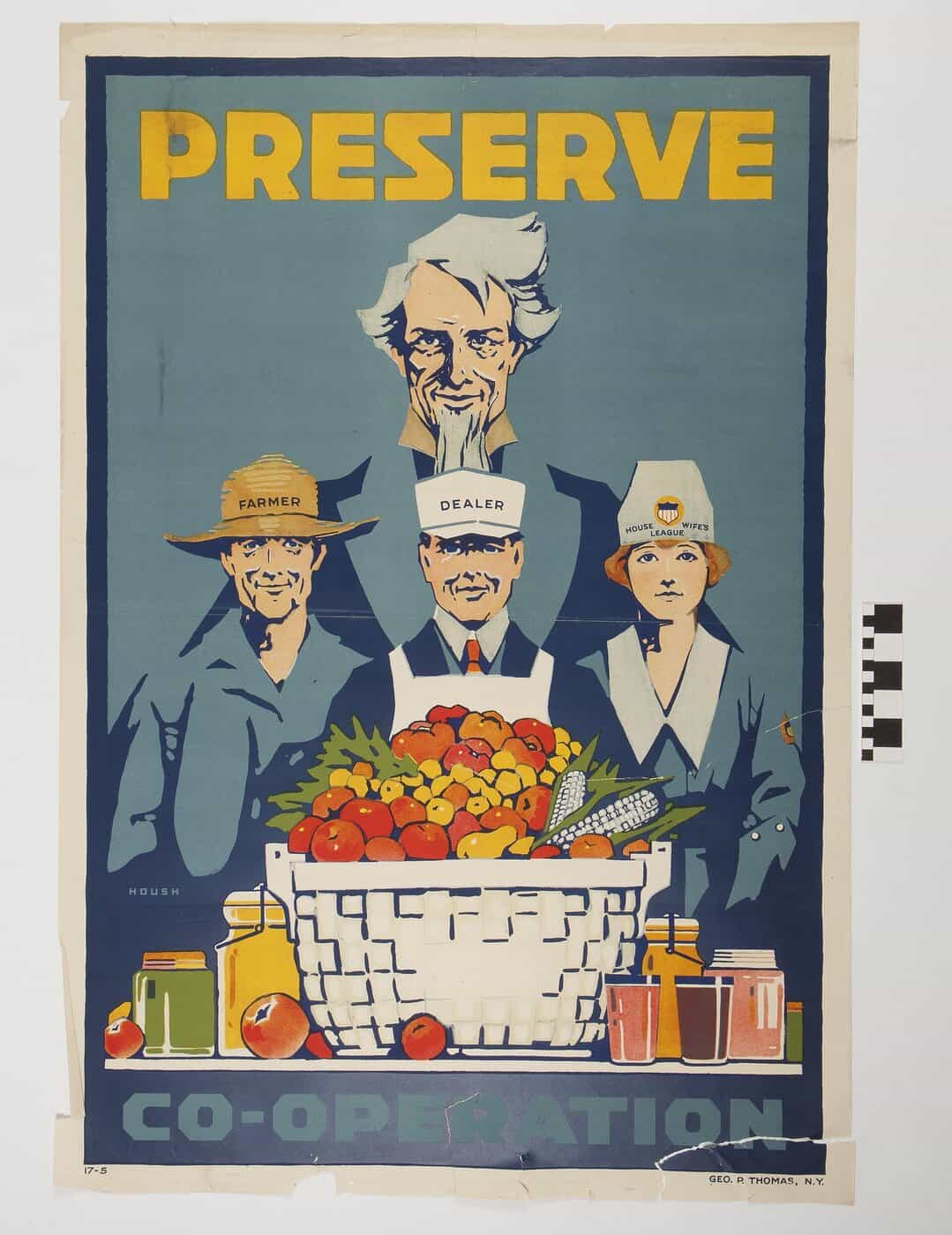
The “Preserve … Co-operation” poster by Carter Housh is in the Missouri Historical Society collections (P0299-00255), with no known copyright restrictions. The “Farmers Must Organize” poster is held by the U.S. National Archives (512504) and is in the public domain.
The two 1918 and 1919 summaries are drawn from the newspaper items cited in the notes below.
- Warrenton Banner (Warrenton, Mo.), Dec. 6, 1918, p. 2, “Treloar.” [↩] [↩] [↩] [↩]
- USDA Economic Research Service, historical overview of U.S. agricultural policies and programs. [↩] [↩] [↩] [↩] [↩] [↩]
- U.S. Bureau of Labor Statistics, War and Postwar Wages, Prices, and Hours, 1914–23 and 1939–44. [↩] [↩]
- Carter Housh, “Preserve … Co-operation,” U.S. Food Administration poster, Missouri Historical Society, P0299-00255, via Wikimedia Commons. No known copyright restrictions. [↩]
- Fred V. Heinkel, testimony to Congress, 1963, recalling the Jan. 1, 1914, masthead of The Missouri Farmer. [↩]
- William Hirth, “The Leadership of Men and Beasts,” The Missouri Farmer, May 1, 1917, republished by MFA’s Today’s Farmer. [↩]
- Converted with the U.S. Bureau of Labor Statistics Consumer Price Index for All Urban Consumers (CPI-U): 1914 annual average 10.0; October 2026, 337.511. [↩]
- MFA’s Today’s Farmer, “MFA at 100, part 1.” [↩] [↩]
- William Hirth, “Why Hirth Is Fighting the Pendergast Machine,” July 4, 1936, State Historical Society of Missouri, via The Pendergast Years (transcription). [↩] [↩]
- Republican Headlight, March 30, 1917, p. 1. [↩] [↩]
- Franklin County Tribune, Oct. 26, 1917, p. 5. [↩]
- Franklin County Tribune, Dec. 6, 1918, p. 8. [↩] [↩]
- Franklin County Tribune, Nov. 29, 1918, p. 4. [↩] [↩]
- Franklin County Tribune, Dec. 20, 1918, pp. 1 and 4 (page 4). [↩]
- “Farmers Must Organize,” ca. 1917–1919, U.S. National Archives and Records Administration, NAID 512504. Public domain. [↩]
- Missouri State Parks, “History of Treloar” historical marker, Treloar, Mo. [↩] [↩] [↩] [↩] [↩]
- State Historical Society of Missouri, professional organizations research guide. [↩] [↩] [↩]
- R. Douglas Hurt, “William Hirth,” Missouri Encyclopedia. [↩] [↩]
- MFA Incorporated, company history. [↩] [↩] [↩]
- The Marthasville Record, Nov. 7, 1919, reprinted in the Warren County Record. [↩] [↩]
- The Marthasville Record (Marthasville, Mo.), Dec. 5, 1919, p. 1, “First Annual Meeting Treloar Farm Club.” [↩] [↩]
- The Marthasville Record, September 1921, as reproduced in the Warren County Record, Sept. 23, 2021, p. 4B. [↩] [↩]
- “Treloar Mercantile” by TCP04, May 2026, CC BY 4.0, via Wikimedia Commons; resized. [↩]